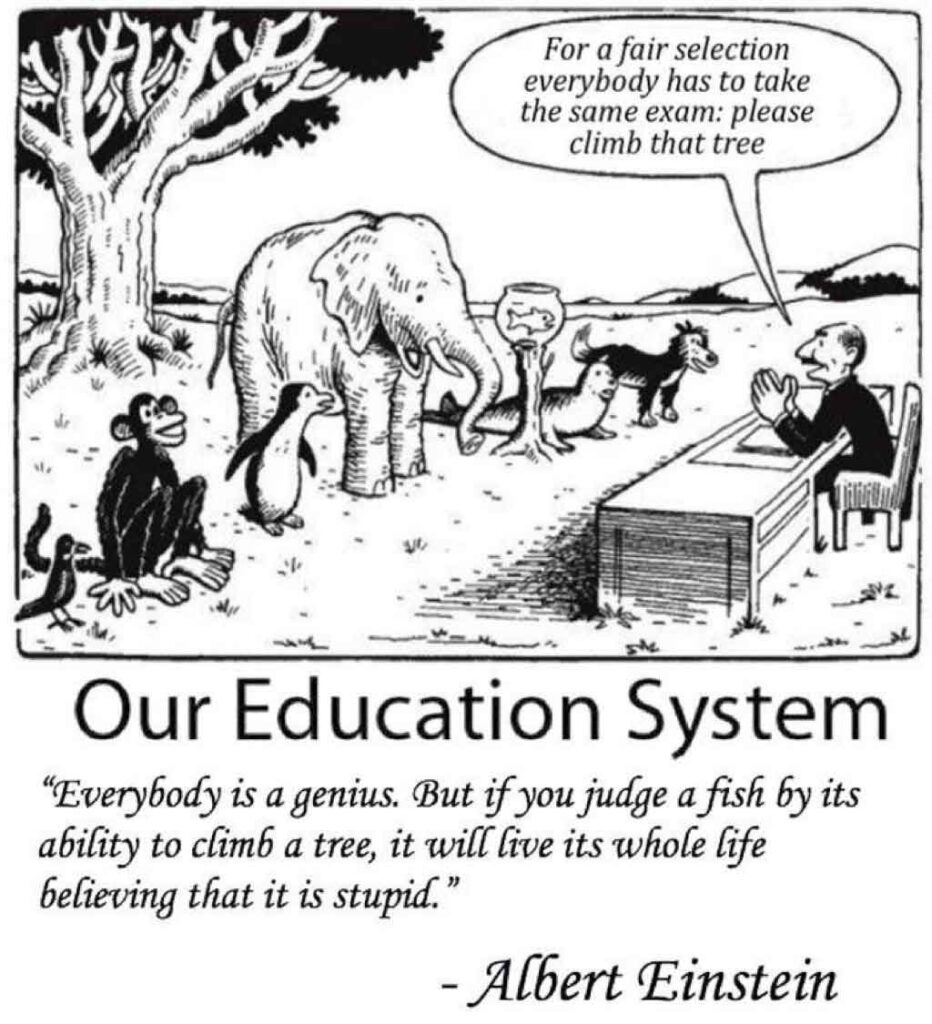
You have probably already come across this quote:
“Everybody is a genius. But if you judge a fish by its ability to climb a tree, it will live its whole life believing that it is stupid.”
Malo Google reklame:
— Albert Einstein
At first glance, everything works. The sentence is short, vivid, and pedagogically appealing. It speaks out against the standardized measurement of all students by the same criteria. It fits nicely into conversations about the individualization of instruction, different abilities, inclusion, and the critique of a school system that expects the same from everyone.
It has one more advantage: it is signed by Albert Einstein.
That is where the problem begins.
Einstein, as far as can be determined, never said or wrote this quote. It is not found in relevant collections of his statements, and researchers who study the origins of quotes have found no convincing trail linking it to Einstein. The current form of the sentence appeared much later, decades after his death, and only subsequently began to spread as an “Einstein quote.”
This does not mean the message is worthless. It means the example is excellent for an exercise in media literacy.
Why Do We Believe Such Quotes?
Falsely attributed quotes work well because they combine three things: a famous name, a simple message, and the feeling that we immediately agree with that message. When a quote confirms what we already think, we are less inclined to check the source. This is called confirmation bias.
In this case, the message is pedagogically seductive. Most teachers, parents, and students can agree that it is not fair to evaluate everyone by the same yardstick. The problem arises when the authority of Einstein is added to that message. Then, the sentence no longer acts merely as a neat metaphor, but as the wisdom of “the greatest mind of the 20th century.”
This is exactly why fake quotes survive.
Step One: Engage Skepticism
A simple rule applies to internet quotes: the more perfect a quote sounds, the more carefully it should be checked.
One should be especially cautious when a very contemporary message is attributed to a historical figure. Einstein, Tesla, Churchill, Lincoln, and similar figures often serve as a “borrowed authority.” Their names are used to make the message sound wiser, more serious, or more convincing.
The question we can ask ourselves is: where and when did this person say it?
If the answer is “I saw it somewhere on the internet,” the verification is just beginning.
Step Two: Search for the Source, Not Just the Repetition
A common mistake is stopping at the first few search results. For popular quotes, this is not enough. Search engines will often throw out hundreds of images, blogs, motivational posts, and quote websites that merely repeat the same mistake.
Repetition is not proof.
When verifying a quote, it is necessary to look for a primary, or at least a reliable secondary, source. A primary source would be a book, letter, lecture, interview, or document where the statement first appears. If that is unavailable, it is useful to consult specialized databases and researchers who investigate the origins of quotes.
In this case, the trail does not lead to Einstein. It leads to a long tradition of pedagogical allegories about animals and school, which criticize the idea of evaluating different beings based on the same abilities.
Step Three: Understand How a Myth is Created
The idea behind the quote did not come out of nowhere. Similar pedagogical fables appeared in the late 19th and throughout the 20th century. In them, animals are sent to a school where they all have to learn the same subjects: swimming, running, climbing, or flying. The duck wastes its time running, the squirrel struggles with flying, and the system fails to recognize their actual abilities.
Later, such stories appeared in different versions, including the famous fable “The Animal School,” which is often associated with George H. Reavis. The modern form of the quote about the fish and climbing a tree only became prominent much later, and in the early 2000s, the false attribution to Einstein also emerged.
In other words, the quote originated as a combination of an old pedagogical idea, contemporary motivational language, and an erroneously added famous signature.
What Can We Learn from This?
The most important lesson is not that we should reject the message itself. The thought that we should not evaluate students solely by a single standardized criterion remains valuable. It opens up important questions about school, assessment, different abilities, and fairness in education.
But a good message does not justify an inaccurate source.
Media literacy does not only mean recognizing fake news in politics or manipulated photos. It also begins with small, everyday things: quotes, memes, inspirational posts, and content we share because we like it.
Before we click “share,” it is worth pausing for two minutes and asking:
- Who really said this?
- Where is the source?
- Is there proof, or just a multitude of repetitions?
- Do I like the quote because it is accurate, or because it confirms what I already think?
It is a small exercise, but an important habit.
Critical thinking is not trained only in grand debates. It is also trained on a single fish, a single tree, and a single quote that Einstein probably never said.