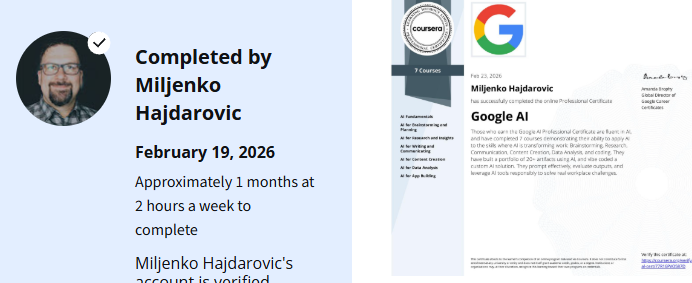
Lifelong learning isn’t an “extra” for me – it’s part of the job. In adult education and project work, the pace of change is such that methods, tools, and expectations keep shifting. If you want to stay relevant, you have to upskill intentionally – not superficially, but through structured programmes that require you to practise and demonstrate what you’ve learned. That’s why I’m glad to share that I’ve completed the Google AI Professional Certificate on Coursera.
What is the Google AI Professional Certificate?
It’s a professional certificate programme designed by Google as a hands-on entry point into using artificial intelligence in real work settings. It isn’t an academic course in machine learning theory. Instead, it’s a sequence of guided courses that build practical competencies: understanding key concepts, applying generative AI in a meaningful and safe way, improving output quality, verifying results, documenting your workflow, and integrating AI into everyday tasks – from planning and writing to analytics and building simple app-based solutions.
Malo Google reklame:
The focus is strongly practice-oriented. You don’t just watch videos and move on; you produce tangible work and build a portfolio along the way.
The certificate consists of seven courses that follow a clear progression – from foundational understanding to applied use:
AI Fundamentals
This course establishes core terminology and concepts: what AI is (and isn’t), where its limits are, what common risks look like (errors, bias, fabricated sources), and how to set basic rules for responsible and safe use.
AI for Brainstorming and Planning
Focused on ideation and planning: how to use AI as a thinking partner to generate options and structures, while setting quality criteria so that “more ideas” doesn’t automatically mean “better ideas.”
AI for Research and Insights
Especially useful for anyone working with information: how to formulate research questions, produce comparisons and summaries, work with sources, and verify claims—spotting gaps and requesting evidence rather than copying outputs uncritically.
AI for Writing and Communicating
Writing here is not just “text generation.” The course emphasises editing, tone, clarity, structure, argumentation, audience adaptation, and producing multiple versions of the same message (short/long, formal/popular) – with a clear reminder that the human remains the editor and the accountable professional.
AI for Content Creation
A practical course on developing learning and communication materials: moving from concept to ready-to-use content, with attention to consistency, visual logic, worksheets, slides, short formats, and reusable building blocks that save time.
AI for Data Analysis
An introduction to using AI for working with data: cleaning, basic analysis, interpretation, visualisation, and validating conclusions. It usefully brings the focus back to “what the data actually shows” instead of merely producing charts.
AI for App Building
A course that often surprises people by showing how, with a well-defined problem, you can build simple solutions (prototypes, scripts, small tools) that automate repetitive tasks. The point isn’t to turn everyone into a developer, but to understand the logic of building tools and to learn how to specify requirements clearly.
What the programme gave me in practice
During the programme, I built a portfolio of more than 20 pieces of work using AI tools, and in the app-building component I created a tailored AI solution. The biggest value, however, wasn’t in the “wow” factor – it was in developing disciplined habits: how to write better prompts, iterate without drifting, assess outputs critically, and document a workflow so it’s repeatable.
For me, the key message is straightforward: AI is only as useful as your goals, quality criteria, and professional responsibility. Otherwise, you get speed without reliability.