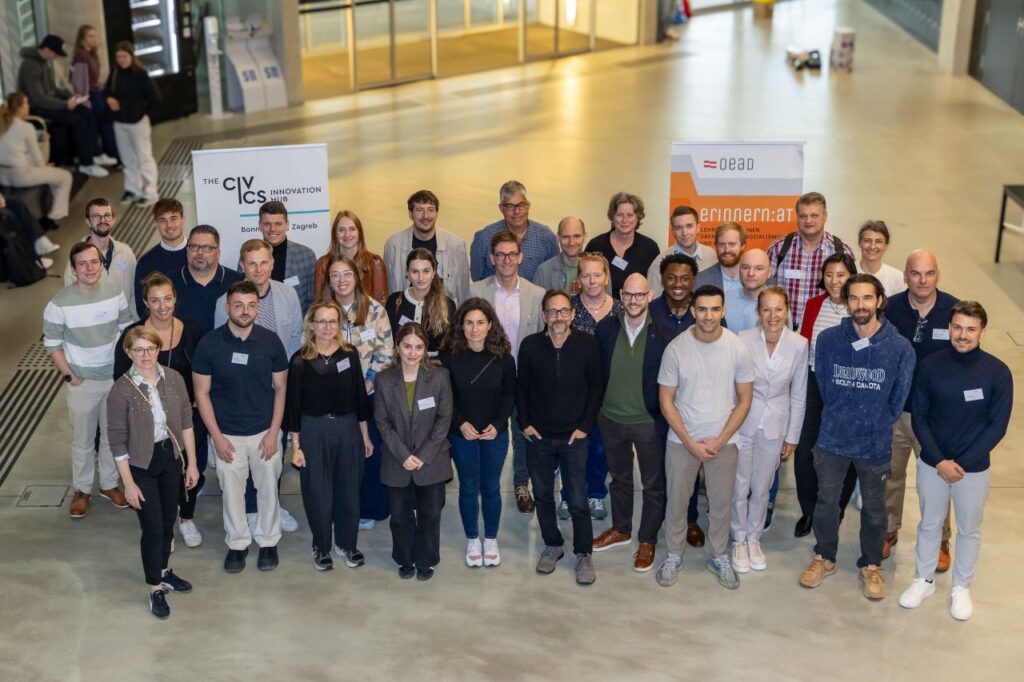
From 16 to 18 September, I took part in the NECE Lab AI and the Future of Historical Learning in Salzburg. Around forty researchers, teachers, museum and memorial professionals, and civil society representatives from fifteen European countries participated. What I found especially interesting was that artificial intelligence was not discussed primarily as a new teaching tool. The more important question was: what does AI change in the way we create, represent, and understand the past?
That is also the main message I took away from Salzburg.
Malo Google reklame:
Generative AI can produce highly convincing historical texts, images, animations, or simulations of conversations with historical figures. The problem is not only whether it can make mistakes. More importantly, the process through which such representations are produced usually remains hidden from the user: which sources were included, what was omitted, and how the information was connected.
For that reason, I would not treat AI-generated content in history education as a neutral transmission of information, but as another representation of the past that needs to be analysed.
This is also clearly visible in AI-generated historical images. Models often rely on stereotypes, predominantly European and American perspectives, and recurring motifs of war, violence, and heroism. Such images can therefore be useful precisely as material for analysis: what do they reveal about the data on which the models were trained and about the cultural patterns they reproduce?
The discussion on metacognition and historical thinking was particularly important to me. AI has not created an entirely new problem; it has made an existing one more visible.
If a student does not know how to analyse a source, distinguish evidence from interpretation, compare perspectives, or explain the basis for a conclusion, then even the best prompt will not help very much. A convincing AI-generated answer may simply hide a lack of understanding.
This is why I think the development of AI will further increase the importance of procedural knowledge in history education. It matters less how many facts a student can reproduce and more whether they can explain how they know something.
Transparency is equally important. At the Lab, we saw examples of animated historical photographs, digital reconstructions, and conversational historical personas. Such projects can be highly engaging, but the boundary between a historical source and newly generated content can quickly become unclear.
If we add movement to a photograph that was never filmed, or allow a historical figure to “answer” questions they were never asked, users need to know where the historical source ends and the reconstruction begins. Simply adding a label saying “AI-generated” is not enough. We should also be able to explain how the content was created.
The programme concluded with a World Café in which we worked in rotating groups to imagine the future of historical learning. The format enabled a rapid exchange of different perspectives, but I was also left with a sense of a missed opportunity. When you have around forty experts from fifteen countries in one place, individual reflections prepared in advance and a more systematic final analysis could have produced very valuable qualitative material.
Still, the greatest value of the Lab was precisely the encounter between different perspectives. AI was not discussed only by technology experts or only by teachers, but by historians, education researchers, museum professionals, memory studies experts, and people developing digital tools.
After three days in Salzburg, I did not leave with a list of new AI tools that should immediately be introduced into classrooms. Quite the opposite.
I left with an even stronger conviction that, in the age of generative AI, the fundamental competences of historical thinking will become even more important.
Students will need to know how to ask questions, verify sources, compare perspectives, recognise the construction of narratives, and assess the limits of their own knowledge.
And perhaps one of the most important questions we can teach them to ask will be:
How was this created, and on what basis should I trust it?