When people talk about artificial intelligence and jobs, two extremes usually dominate. On one side, we hear that AI will soon replace workers on a massive scale. On the other, we hear that the whole debate is exaggerated and that nothing serious is really happening yet. That is exactly why Anthropic’s (makers of Claude) new report is interesting: it tries to offer something more concrete. It does not only ask what AI could do in theory, but where it is already being used in real work and what first effects can already be detected.
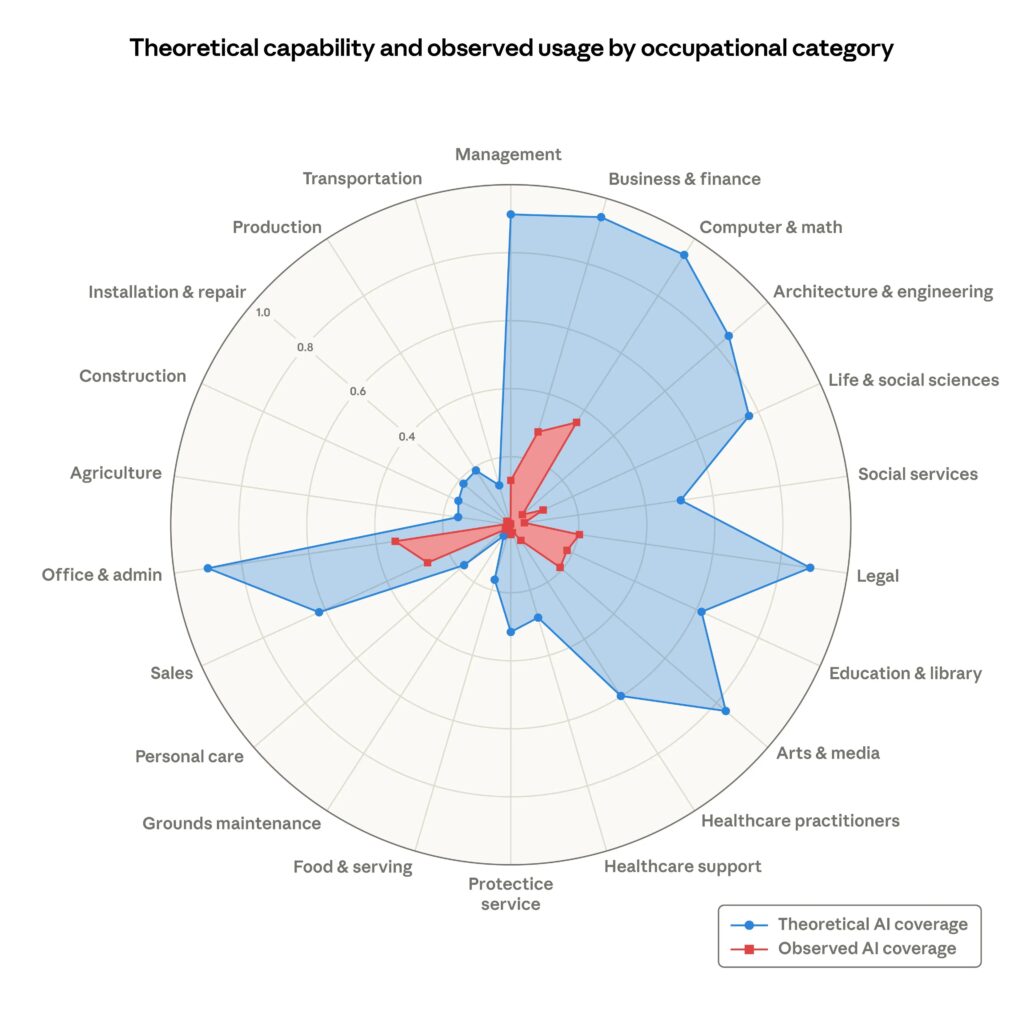
The main message of the report is fairly clear. Artificial intelligence has not yet overturned the labour market, but changes are already visible. And they are not visible everywhere in the same way. The jobs currently most exposed are those based on text, information, analysis, and computer-based work. This includes, for example, programming, administrative work, customer support, data analysis, and similar occupations. By contrast, jobs that involve physical work, direct human contact, or specific practical skills are, for now, much less affected.
Malo Google reklame:
One of the most important points in the report is the difference between what AI can do and what people are actually using in their everyday work. That gap is still large. In other words, technical capability alone does not mean that a full transformation has already happened in practice. The adoption of AI tools also depends on trust, regulation, habits, workflow design, and people’s willingness to integrate them into daily tasks.
One of the more interesting findings is that there is still no clear sign of rising unemployment in jobs that are more exposed to AI. This means that AI is not, at least for now, causing mass layoffs. However, the report does point to one possible early signal of change: younger people may be finding it harder to enter some occupations that are more exposed to AI. That is an important observation, because major labour market shifts often do not begin with dismissals, but with the fact that beginners struggle more to get their first job and gain initial experience.
The report also challenges a common assumption. At this early stage, AI is not affecting only lower-paid or less educated workers the most. On the contrary, higher exposure is more visible in better-paid, more educated, and office-based occupations. This is a reminder that generative AI is not reshaping the labour market in the same way as earlier waves of automation.
For me, the most important message of the report is this: we should neither panic nor downplay the changes. Instead, we should pay close attention to what is actually changing. AI may not yet have caused a major shock, but it is already changing certain tasks, employers’ expectations, and the pathway into some occupations. That means education and lifelong learning need to respond in time.
Today, it is no longer enough simply to “know how to use an AI tool.” Skills such as verifying information, critical thinking, clear communication, adaptability, and understanding the broader context are becoming increasingly important. These human competences are likely to become even more valuable in a world of work where AI is becoming an assistant, a filter, an accelerator, and sometimes even a competitor.
Anthropic’s report should therefore not be read as a prophecy about the end of work, but as a warning that change has already begun. It may not yet be spectacular, but it is real enough that we should not ignore it.