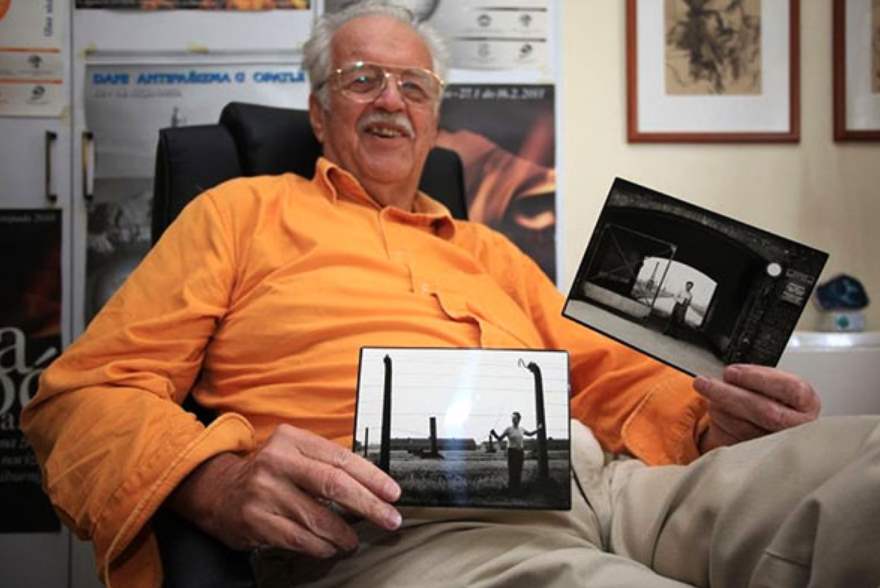
In one of his many interviews in recent years, Oleg Mandić said: “I had a wonderful life thanks to Auschwitz.” Oleg, along with his mother and grandmother, was the last surviving prisoner to leave Auschwitz a month after its liberation. The death camp was liberated by Red Army soldiers on January 27, 1945. Today, that day is regularly commemorated as the International Day for the Remembrance of the Holocaust and the Prevention of Crimes against Humanity.
Thanks to the Red Army propagandists of the time and today’s YouTube, you can watch Oleg in the liberated Auschwitz in the following video.
Malo Google reklame:
Still vital at 83, Mandić regularly testifies about events from more than 70 years ago. From the numerous interviews that can be found online, I highlight the confessions published in the daily newspaper 24 Sata.
I was given the number 189488 with a red triangle, male. Mom was given the number 82603, and Babushka was given the number 82604, female. Jews had their own series, and those who came to Auschwitz for just one day were without a number, and because of that, the exact number of victims was never determined. After the numbers were tattooed on our left forearms, we went to the shower naked in a chain. Behind that room, we came across a pile of clothes taken from other camp inmates. The clothes had a wide, longitudinal red line on the back, applied with ordinary paint. Everyone took something for themselves. We spent the whole day there and only in the evening did we come to the barracks, ours had the number 8, and so I simply became and was just a number – 189488. There were 700 of us in each barracks. We slept in cots or wooden holes. There was enough room for 12 of us. The prisoners slept in such a way that six of them had their heads in one direction and the other six in the other. They slept in the same clothes, and shoes were used instead of pillows so that no one would steal them. Stealing was allowed because it was a way of survival, and the word for stealing was ‘organize’.
WHY TEACH ABOUT THE HOLOCAUST? The Holocaust is an unprecedented event in human history. The Holocaust demonstrated how modern society can use technology and bureaucratic infrastructure to attempt to exterminate and destroy the culture of a group of people. The topic of the Holocaust provides a context for exploring the dangers of silence and indifference to events that affect “others”. Learning about the Holocaust helps students think about the abuse of power, the responsibility of individuals, groups and nations in the event of human rights violations.
Students develop a sense of the value of diversity in society and an awareness of the need to protect minorities. They recognize the complexity of historical processes and how the combination of multiple events can lead to the collapse of democratic values.
Teaching about the Holocaust is an integral part of the current and future history curriculum. Basic teaching guidelines direct teachers not to base the topic solely on victims.
Such a topic could be reduced to numerical statistics and descriptions of suffering from which students would not learn lessons or educational outcomes would not be achieved.
The teaching guidelines give victims their names and faces back. By researching and portraying their lives before the Holocaust, victims cease to be just numbers.
Find out more about the teaching guidelines on the AZOO website.
iWitness
The basic guidelines state that primary sources and available testimonies are used in teaching to explain personal fates and the context of events. In 1993, the famous director Steven Spielberg, together with producer Branko Lustig, made the film “Schindler’s List”. Poldek Pfefferberg, one of the survivors of “Schindler’s Jews”, had been trying to make a film about his savior since 1963. Spielberg did not feel ready to make a film about the Holocaust for many years, so he offered the story to other directors. He finally accepted the job with the desire to contribute to his Jewish heritage and under the influence of the increase in the number of neo-Nazis in the early 1990s who denied the Holocaust. The film was mostly met with numerous good reviews and was included among the cultural assets preserved in the Library of Congress (National Film Registry). Among the numerous awards (7 Oscars, 3 Golden Globes, 3 BAFTAs, etc.), Branko Lustig also received the award for best film with Spielberg. Lustig is of Jewish origin from Osijek, and survived the Auschwitz and Bergen-Belsen concentration camps during the Holocaust.
After filming the film, Spielberg decided to preserve as many of the survivors’ personal memories as possible. He founded the USC Shoah Foundation Institute for Visual History and Education. The institute currently preserves more than 53,000 recorded testimonies that provide us with a unique insight into the past. Testimonies last an average of about two hours and were recorded in 63 countries in 39 languages. Most testimonies contain the entire personal history of a person from before, during, and after the victim’s experience with genocide. The Visual History Archive is digitized, easily searchable, keyword-indexed, and link-indexed by minute. More than 11,000 hours of memories allow users to independently research a variety of topics. Indexing allows students, teachers, researchers, and others to research using 63,000 keywords and phrases, 1.8 million names, and 695,000 image sources.
The “Archive of Memory” contains topics such as Jewish survivors, rescuers and helpers, Roma survivors, liberators, political prisoners, Jehovah’s Witnesses, participants in war crimes trials, survivors of eugenics, forced laborers, homosexual survivors, etc. In addition to the Holocaust, the archive preserves testimonies from survivors of the Nanking massacre (1937), survivors of the Armenian genocide (1917), and Rwanda (1994). There are plans to expand to include events in Guatemala and Cambodia.
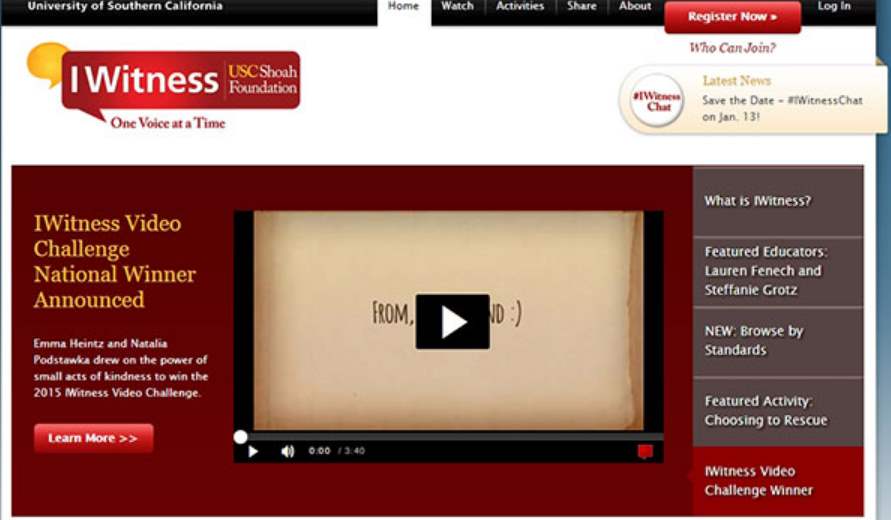
The archive has adapted the research to the needs of teachers and students with the help of specialized tools on the iWittnes portal.
About 1,500 testimonies are available on this portal, which can be used in various ways. Registration is free and each teacher can create their own “class” to which they forward materials and assignments. The basic equipment you need for work is a computer connected to the Internet, speakers (or headphones) and a monitor (or projector for a larger display).
WHAT CAN YOU DO ON THE iWittnes PORTAL? The main thing you can do is watch testimonies and learn about the lives of men and women who survived the Holocaust. Students can independently search for testimonies, watch them at school or at home, and start and stop the recordings according to their interest and concentration. Then there is a tool (video editor) available for creating your own video projects. You can find testimonies that interest you, cut out certain parts and use them at your own discretion. Then you can search the encyclopedia of terms and photos that further explain the testimonies. By preparing your own digital materials, you develop digital literacy. There are also a number of ready-made lessons.

A registered teacher can form working groups to which he assigns tasks and sends messages. Work tasks (activities) can be video editing and preparation activities, in-depth research and search for information about a specific event or witness, or small challenges in which students learn based on a more detailed investigation of the assigned activities.
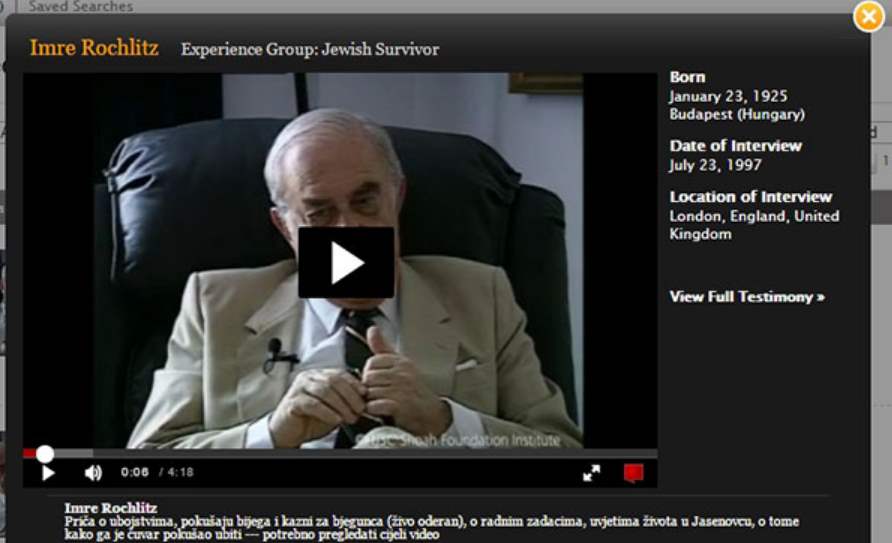
Testimonies from Croatia are available. For example, a search for the word “Croatia” lists 31 video clips, 81 encyclopedia entries, and 26 photographs. The “Visual History” archive contains 395 witness testimonies in Croatian. Several Croatian teachers, under the guidance of senior advisor Loranda Miletić, prepared teaching materials in Croatian in 2006:
■ JEWS IN THE ANTI-FASCIST STRUGGLE
“Jews in the Anti-Fascist Struggle” depicts Slavko Goldstein, a 12-year-old boy, and his decision to join the national liberation movement. The unit is intended for elementary school students as part of history classes.
■ THE FATE OF LEE DEUTSCH
The teaching unit “The Fate of Lee Deutsch” depicts the life and suffering of the first Croatian child actor. It is intended for use with elementary school students.
■ SUFFERING OF WOMEN AND CHILDREN IN THE JASENOVAC CAMP
“Suffering of Women and Children in the Jasenovac Camp” deals with the fates of women and children, prisoners of the Jasenovac concentration camp. It is intended for students in the fourth grade of high school. Video testimonies of surviving prisoners Gabriel Winter and Pava Peršić Molnar reveal the suffering they personally experienced and the suffering of other prisoners they witnessed.
■ DEPORTATION OF THE NDH POPULATION TO USTASHI CAMPS
Using photographs, documents and the personal story of Bjanka Auslender, a Jewish woman from Sarajevo, a prisoner of the Ustasha camp for women and children in Đakovo, “Deportation of the NDH Population to Ustasha Camps” attempts to depict the deportations to Ustasha camps, one of the most moving segments of the Holocaust in the so-called Independent State of Croatia. The teaching unit is intended for history students in the final grades of high schools.
■ RESPONSIBILITY
Responsibility is intended for high school students. It is designed as a series of independent student tasks in close correlation with psychology, through which students become aware of the importance and possibility of independent and responsible individual action. A video testimony by Ružica Breyer was used, which talks about brave individuals who risked their own lives for the idea of humanity. A strong psychological impression is left by the final part of the lesson, which uses quotes and questions to direct students to responsible action within civil society.
■ COLLABORATION, CONFORMISM, CONFRONTATION
“Collaboration, Conformity, Confrontation” deals with the complexity of human behavior in World War II. By questioning how it was possible for members of civilized nations to behave so inhumanely towards each other in the 20th century, the students are asked the question of personal responsibility, or whether individual choice is possible even in such difficult moments. It is intended for students in the second year of secondary vocational schools and fourth years of grammar schools.
■ THE FATE OF THE CAMP INMATES IN THE CROATIAN TERRITORY OCCUPIED BY THE FASCIST KINGDOM OF ITALY
The fate of the camp inmates in the Croatian territory occupied by the fascist Kingdom of Italy implies that students have mastered the key competencies about the creation of the Independent State of Croatia. The teacher can choose from the offered materials and methodological procedures what suits him best in the didactic design of the teaching unit. The adverbs are used according to the order of development of the teaching unit. It is recommended to hold the teaching unit in a block class.