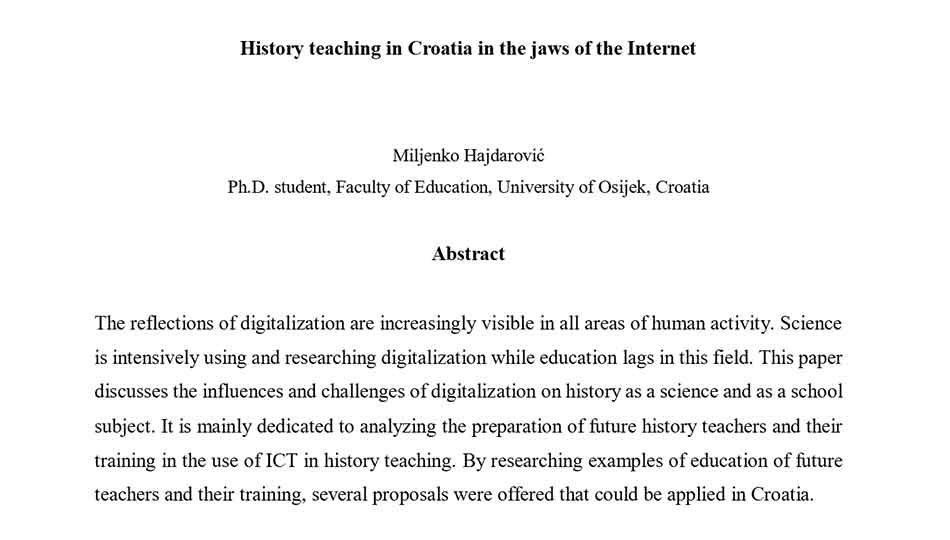
In everyday teaching practice, we often reach for powerful quotations. They neatly “close” a lesson, motivate students, or serve as a starting point for discussion. Precisely for that reason, they are also ideal material for practising media and digital literacy. One seemingly harmless example opened up a highly instructive methodological lesson.
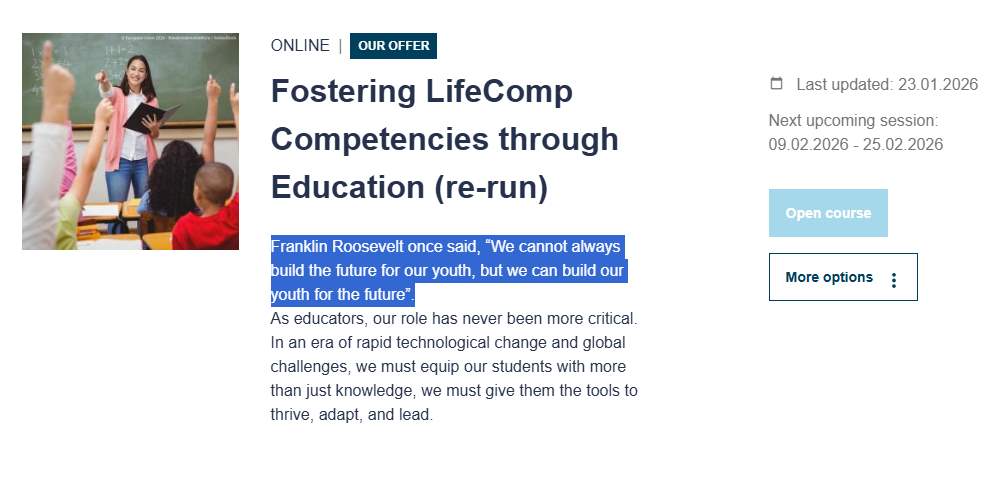
The case in point is the well-known saying: “We cannot always build the future for our youth, but we can build our youth for the future.” The quote is almost universally attributed to Franklin D. Roosevelt. It appears in textbooks, on motivational posters, in publications by educational institutions, and across social media. As a historian and educator, it seemed reasonable to ask a simple question: is the attribution actually correct?
Malo Google reklame:
The first step was to use generative AI tools that teachers themselves increasingly rely on when preparing lessons. ChatGPT and Gemini reacted in a similar way. Both warned about the common phenomenon of “apocryphal quotes” – sayings that, over time, come to be attributed to famous individuals without a clearly identifiable primary source. Their conclusion was cautious: the quote is consistent with Roosevelt’s policies and rhetoric, but it is very likely a later paraphrase, a distilled version of a longer and more complex passage from a speech about the role of education. In other words, it “sounds like Roosevelt,” but they could not confirm that it was a verbatim quotation.
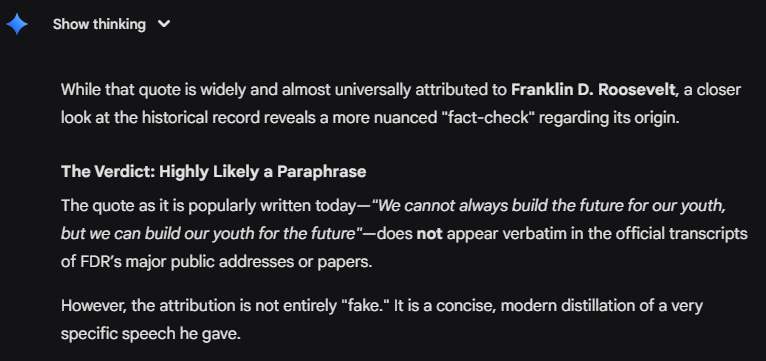
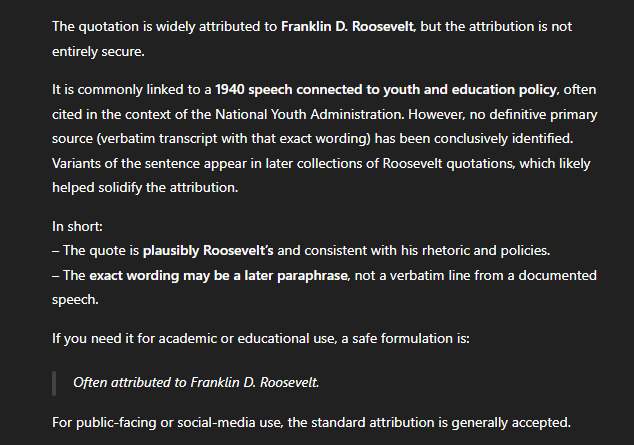
Such an answer is not, in itself, incorrect. It highlights one of the key characteristics of generative artificial intelligence: these models are exceptionally good at assessing probability, discourse, and patterns, but they are cautious when they lack high confidence in a primary source. This already offers an important didactic point for teachers and students alike – AI often correctly signals uncertainty, but it does not always pursue archival verification to its very end.
A third tool, Perplexity, produced a different result. Instead of relying primarily on secondary interpretations, it focused on verifiable sources. The outcome was clear: the quotation does indeed appear in a speech delivered by Franklin D. Roosevelt on 20 September 1940 at the University of Pennsylvania, as part of the university’s Bicentennial Celebration. The transcript of the speech, available through the American Presidency Project at the University of California, Santa Barbara, contains the sentence exactly as quoted, near the end of the address, in the context of a discussion about the role of education in a time of global threats.
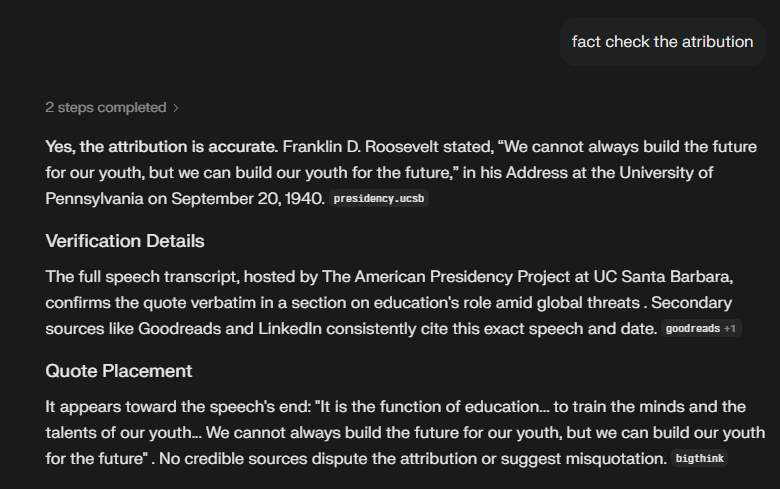
This is where the key educational value of the entire process becomes evident. We have three AI tools, all “intelligent,” yet operating in different ways. Two remained at the level of interpretation and caution; the third identified a primary historical source. None of these responses is useless – on the contrary, it is precisely their comparison that provides a complete picture.
For teachers, this serves as an excellent example of how to design a media and digital literacy exercise with students. First, it demonstrates that neither authority (in this case, a famous president) nor the widespread circulation of a quote guarantees its accuracy. Second, it illustrates the difference between secondary sources, summaries, and paraphrases on the one hand, and primary historical documents on the other. Third, it clearly shows that AI tools are not a single, unified “oracle,” but rather instruments with different strengths and limitations that users must learn to recognise.
One additional dimension deserves particular emphasis: critical thinking does not mean automatic distrust, but systematic verification. In this case, doubt proved useful, yet the final conclusion supports the accuracy of the attribution. Roosevelt did, in fact, say these words. The difference lies in how we arrived at that knowledge – not by a single click, but through a process.
At a time when students – and teachers as well – increasingly use artificial intelligence to obtain quick answers, examples like this remind us of the fundamental task of education: to teach how knowledge is produced, not merely what the answer is. For that reason, a small but precise fact-check of a quotation can become a powerful lesson in responsible use of digital tools, engagement with historical sources, and intellectual integrity.