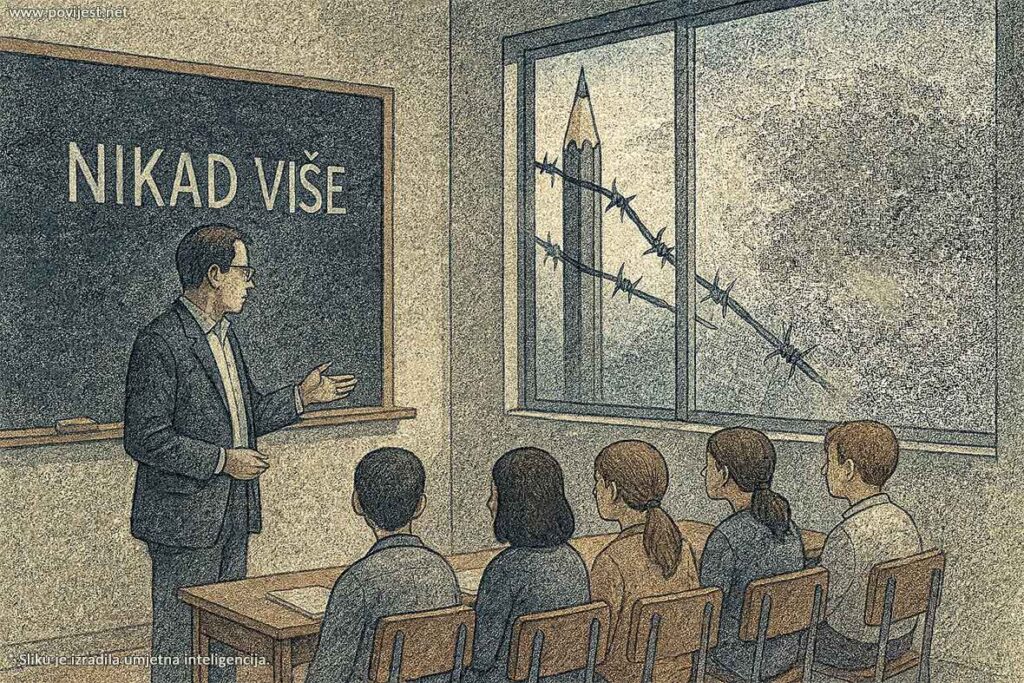
Teaching about the Holocaust is a mandatory part of the history curriculum and thus an indispensable task for every teacher and educator. However, the current war between Israel and Hamas, accompanied by reports of potential war crimes and ethnic cleansing, places this topic in a new and highly sensitive perspective. As students follow the news daily and ask questions, teachers face additional pressure: how to preserve the uniqueness of the Holocaust while simultaneously enabling students to critically reflect on the present, without simplified comparisons and dangerous generalizations. This text builds upon previously published discussions on the role of educators and seeks to open a space for reflecting on pedagogical challenges in a time when history and contemporaneity strongly intersect.
Continuing the reflections from the previous text on the lessons of the Holocaust and the responsibility of educators in times of crisis, it is worth addressing the current moment in which the State of Israel is waging war against Hamas, while the international community simultaneously warns of potential war crimes and the ethnic cleansing of Palestinians. It is precisely in this context that teaching about the Holocaust gains additional weight, as teachers are confronted with a complex question: how to preserve the historical uniqueness of the genocide against European Jews, while at the same time imparting to students universal lessons about the dangers of dehumanization, discrimination, and institutionalized violence that may also be applicable to today’s conflicts.
Malo Google reklame:
The Holocaust is a paradigmatic example of a process in which stereotypes, hate speech, and gradual legal and social exclusion paved the way for mass extermination. This dynamic must never be forgotten, yet any simplified equating of contemporary conflicts with the Holocaust is equally dangerous. It is necessary to clearly distinguish what is comparable—linguistic patterns of dehumanization, collective punishment, or systemic discrimination—from what remains historically and morally incomparable, namely the industrially planned extermination of an entire people.
In such a pedagogical environment, it is especially important to give students the space to freely express critical views on the current situation, to attempt to argue their opinions, and to explore both current events and the historical context of the Holocaust. The teacher’s task is not to steer students toward predetermined conclusions, but rather to enable them to develop the critical apparatus and skills necessary to distinguish the historical uniqueness of the Holocaust from contemporary tragedies. This also includes the obligation to warn students about the danger of hasty and inaccurate comparisons, such as calling current events a “new Holocaust,” as this trivializes history and strips the present of its complexity. It is equally important to equip young people to avoid the demonization of Jews and not to equate an entire people with the policies of the current political regime. Such generalization not only reproduces the patterns of hate we teach against, but also hinders the development of sensitivity to the complexity of social and political relations.
The task of the history teacher is not to reduce the past to a political argument, but to enable students to develop the capacity for critical thinking and ethical reasoning. In this sense, the classroom becomes a space that cultivates a sensitivity to language, an understanding of how propaganda narratives shape the perception of the “other,” and an awareness of the universal value of human dignity. Teaching about the Holocaust simultaneously demands emphasizing the uniqueness of that genocide and encouraging reflection on how mechanisms of exclusion and repression can be identified in the present day.
In a time when the media landscape delivers images of wartime destruction in real time and students are exposed to polarized interpretations daily, the responsibility of the teacher is even greater. Teaching about the Holocaust is thus not merely the transmission of historical facts, but also a form of moral orientation: a reminder that “never again” must remain a universal principle, regardless of who holds power at a given moment or who is the victim of its abuse. It is precisely this universality that lends strength to classroom discussions, making them a place where past and present converge in ethical reflection on the future.